
Fashion / Fashion boutiques

For fashion boutiques.
A more relevant approach.

Curatorial voice, store experience and enquiry paths.

Last updated · Reviewed by the FashionBrandX team

The starting situation

Connect the edit to a local audience.

Curatorial voice, store experience and enquiry paths. The first step is to check what already works and identify the specific gap. A different business type should not receive the same campaign and reporting plan by default.

The story disappears after the first few posts. Our proposed response: Plan a sequenced collection narrative and follow-through.

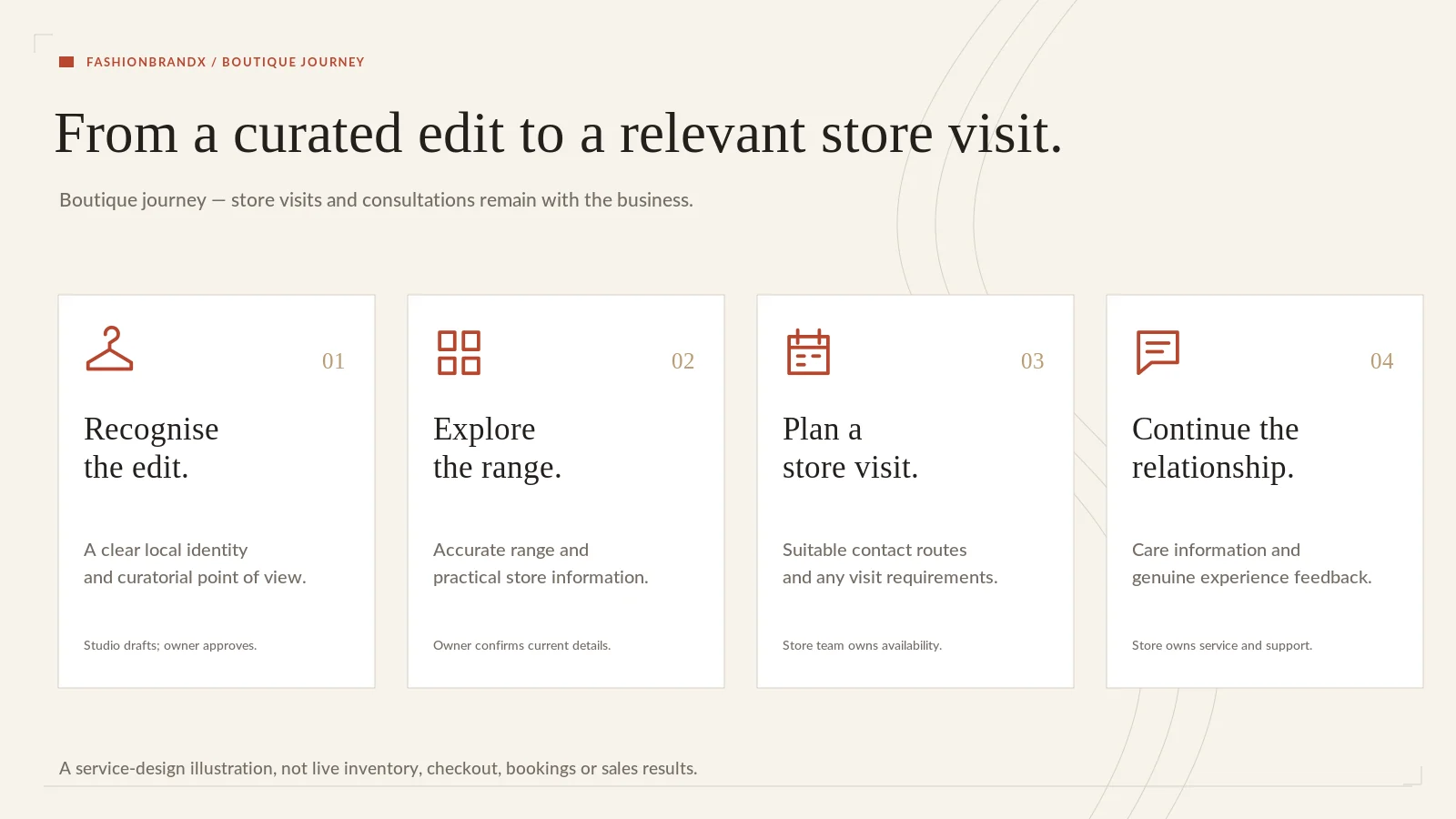
Diagram: curated edit to store visit — recognise the edit, explore the range, plan a relevant visit, continue the relationship
The customer experience

Collection-to-community system.

These are the stages we design around. Open the interactive map to inspect the work and handoff.

  1. 01

    Notice

    Introduce a specific collection idea and visual language.

    Campaign direction
  2. 02

    Explore

    Explain the range, materials and client-supplied fit information.

    Collection and product pages
  3. 03

    Choose

    Make the ordering route and policies easy to understand.

    Purchase-support journey
  4. 04

    Return

    Listen to feedback and communicate relevant future collections with permission.

    Retention and reputation plan
What we would review

Measures that match
this business journey.

  • Product consideration actions
  • Recorded purchase handoffs
  • Net orders after returns when shared
  • Repeat-customer activity when available
No fabricated scarcity, sustainability credentials or customer content. Pricing, stock, returns and material claims must be approved. Commerce operations remain with the client.
Ways to work

A defined engagement.
A clear starting point.

Choose the type of help you need. Each engagement is standalone; scope is confirmed before any commitment.

Find the real problem

Diagnose the problem

Not sure what is really holding the business back? Start with an evidence-backed diagnosis and a clear priority.

from₹30,000 one-time
  • Review of your agreed records and current customer journey
  • Customer questions, objections and alternatives reviewed
  • A baseline for purchase conversion and returns
  • Positioning and messaging recommendation
  • An evidence-backed diagnosis: priorities and what can wait
  • A clear, written scope for the fix
Keep it improving

Operate & improve

Keep the fixed journey working: monitoring, updates, workflow maintenance, suitable experiments and honest reporting.

from₹1,00,000 / month
  • Monitoring of the journey and information accuracy
  • Information updates and workflow maintenance
  • Suitable experiments with comparison periods
  • Verified product-claim register
  • Monthly work log, issues resolved and next decisions

Proposed planning fees, not a binding quotation. Media spend, applicable taxes, software, on-site shoots, travel, custom development and specialist review are additional unless explicitly agreed. No sales, ranking or conversion guarantees.

Fashion boutiques: questions

Before fashion boutiques
commission anything.

Still unsure? Ask us directly.

What does FashionBrandX do for fashion boutiques?

Connect the edit to a local audience. The work covers curatorial voice, store experience and enquiry paths, measured to a kept order, not a return.

Where should fashion boutiques start?

Start with the gap closest to the customer’s decision. A common one: the story disappears after the first few posts. Our first response: plan a sequenced collection narrative and follow-through. If the problem is unclear, Diagnose the problem (from ₹30,000) finds it first.

How much does branding for fashion boutiques cost?

Proposed starting fees are ₹30,000 for Diagnose the problem, ₹55,000 for Fix my product-to-purchase journey and ₹1,00,000 per month for Operate & improve. The final quotation follows a written scope; taxes, media spend and third-party costs are extra.

The next considered step

A point of view, not a template.
Let’s start there.

Tell us about the business, the gap and the work you need. Start with a useful brief—not a bigger package.